
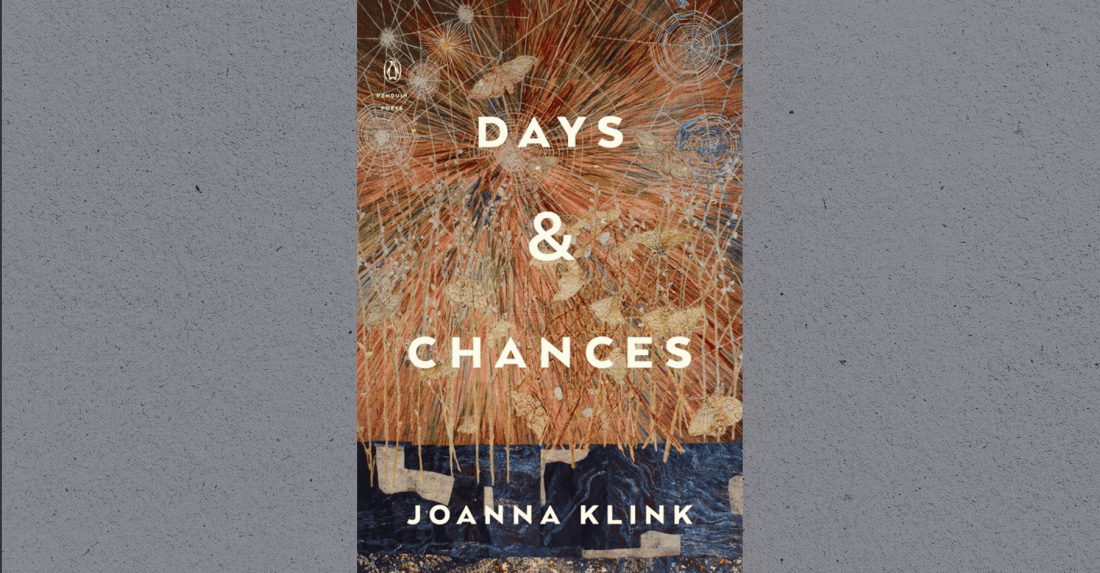
Do geese sense “the scrambling of days” as we humans do? Who among us ever “touches the whole of / their lives?” And how can I, fleeting moment in the world, “attend to what I can barely sense?” These are some of the questions that linger in the mind while reading Joanna Klink’s newest collection of poems titled Days & Chances, this phrase coming from a line from Claire Keegan’s Small Things Like These. Something this collection succeeds at, as Klink’s prior work also has, is the poems here present a kind of frosted-glass effect across their myriad subjects as though looking out from a fogged window in late autumn or early winter. A speaker often spies, or thinks they spy, an exact subject, and remarks upon it, only for it to become elusive, to change, though not always physically, as it approaches or persists in the memory, in the language, in the poem.
Occasionally the poet folds language or imagery over on itself in a kind of imagistic collapse. A moment like this in “A Plain Field” brings to life its image: “…the sky seems to flood / my hands with the white light of gold. / And the last coal train’s train-horn, / deep, slow, drifting out…” The image of the train horn is abrupt after the softness that precedes it. This is compounded by the choice to not have only one — last coal train, or last train-horn — but both. The butting-up of the plosive sounds of “coal train” and “train-horn” help this image into a kind of exploding effect. This moment, in the middle of the poem, rocks the speaker, and reader, back to life within the fading light of the moment throughout the rest of this poem. Before the train, the speaker notices nature’s “sureness” but seems to question it for themselves, or distrusts their ability to notice. After the train, however, the speaker cannot help but reckon with the “richness that will persist” in the field.
Subjects in Klink’s poems range from memory, the Rothko Chapel, dementia, aging, marriage, natural landscapes, and birds. Nearly all of these are approached with a delicate tension akin to hearing snowflakes settle in blankets of ice. One can almost feel this reverent tip-toe in “Hospital Interior,” a highlight of the collection:
…You might glimpse
a man being erased
by pain—or light sweeps
his frame, as sun might
sweep a field. In the long
dusk of the hospital
chapel, backless wood
benches are laid out for
contemplation…
These short-lined tercets, with only two or three beats per line, not only contain the shifting mind or image of other poems in the collection but also have the effect of a whisper in this quiet place so as not to disturb the subject we peer in on.
At times there are strange, almost disjointed line breaks on articles or adjectives within a line’s syntax, which render an image temporarily estranged from us like this moment in “Farm Wedding”: “we spoke on the / gravel drive before.” There seems to be no overwhelming reason for this particular break to land on “the.” However, at other times, this strange disjunction works well with the image at hand and amplifies the effect of the mind hunting for or fumbling with its recollection of an image. In “Landfall,” “[o]nce more the smell of / woods, the vanishing space / between cottonwoods.” The poem exists simultaneously with the speaker’s experience. The speaker tries to place the exact smell and lands on “woods,” but, no, this isn’t quite right — and then, similar to the train-horn, turns back and adds to our understanding: cottonwoods, specifically. The frostiness of the lyric in Days & Chances means we’re invited to sit with the speaker not as they relay narrative or recite a polished song, per se, but actively piece together reality and it asks us to be patient with that voice as they do so.
All the aspects of the poems together begin a kind of collapse of the speaker with their subjects. For example, in “Wood Doves,” near the beginning of the collection, a flock of doves, “who spoke their / feeling by not moving,” huddle against one another in a tree as they, and the tree, are relentlessly buffeted by a windstorm while the speaker witnesses them. A few poems later, the speaker says, “…your arms, their deep / warmth, which I can forget myself in, and fly from, / like wood doves at evening in the live oaks.” Similar to the cottonwoods and coal train, the speaker brings the image of the wood doves back and becomes them via this simile. When we return, then, to a question like “[t]he birds / can’t rest on grounds / stripped of willows. Will / no one stop it,” we read this as being of two worlds, animal and human.
This collection implores us to keep close record of our own days, our own chances, that won’t return to us, even if they are, at times, unpleasant, because we only get this one, glittering opportunity at existing here. Klink’s collection stands resiliently solid amidst each of its poem’s disappearing, and reappearing, acts like a flag, a little frayed, a little tattered, saying I am still here as in “Hospital Interior:” “[snow] falls against / the cars in the lot that have, / for many nights, not moved.”
POETRY
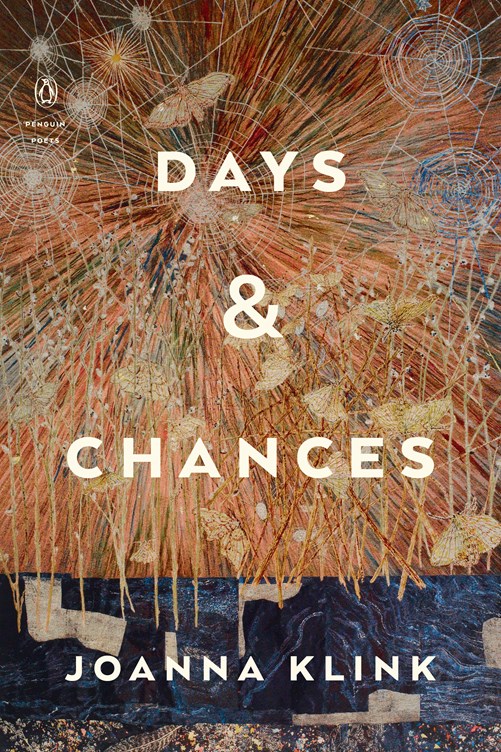
Days & Chances
By Joanna Klink
Penguin Books
Published September 15, 2026


